Eight Republican-Held Texas Senate Seats Are on the 2028 Ballot. Most Are Suburban; a Few Reach Into Rural Texas.
Rural Texas turnout and vote choice shifted in the 2026 election. Will that pattern hold in 2028?

Fifteen of the 31 seats in the Texas Senate will be on the 2028 general election ballot. Eight of them are held by Republicans. Texas Tribune politics editor Jasper Scherer pointed to those eight districts in a Nov. 9 post on X. He shared district-level figures from The Texas Elections Observatory that show how each district voted this month for U.S. Senate and governor. This article looks at those numbers and at a question that matters to rural readers: how much of rural Texas these eight seats actually cover.
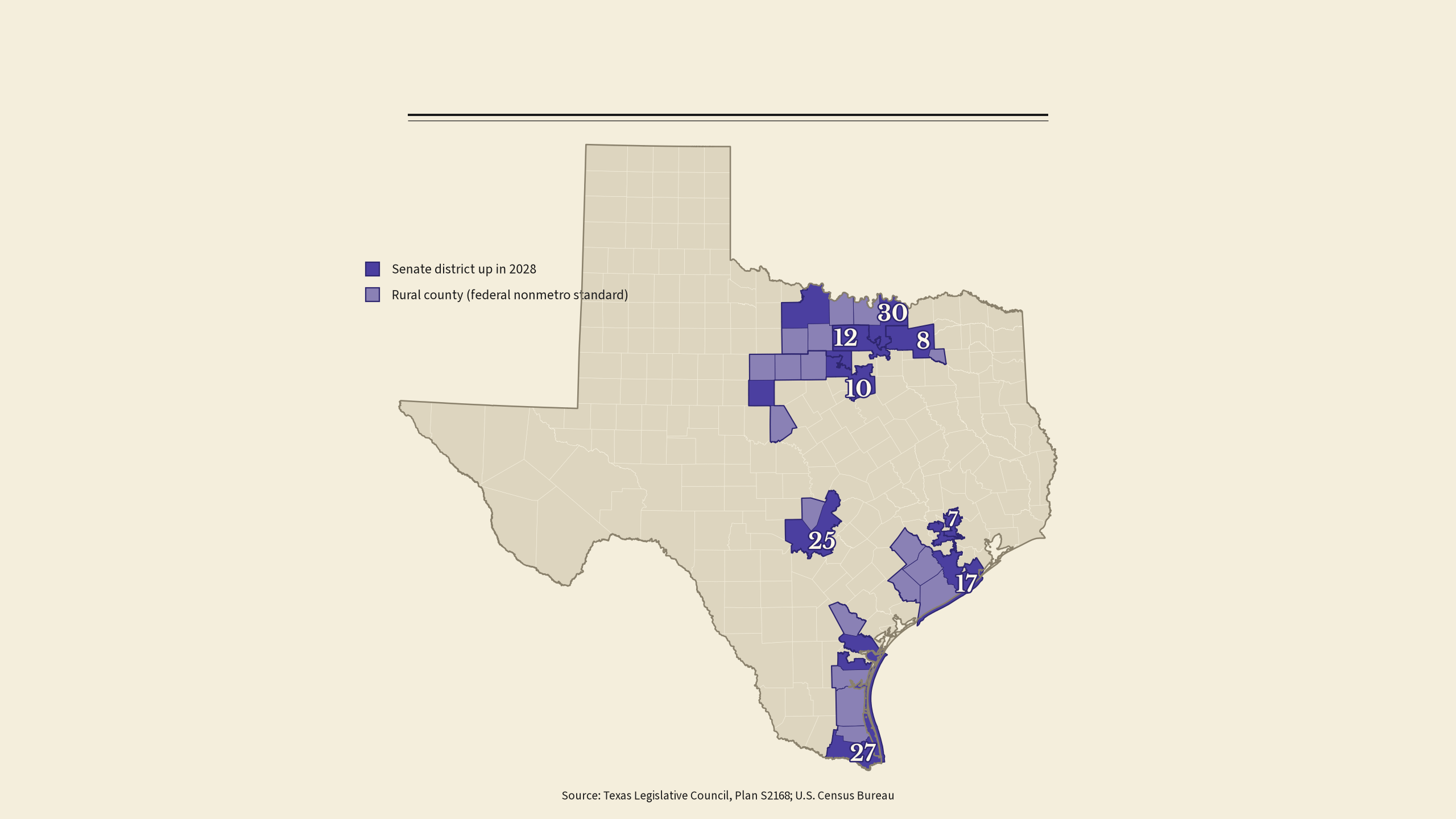
Why These Seats Are Up in 2028
Texas state senators serve staggered four-year terms. Fifteen senators were elected in November 2024 to terms that run through the 89th and 90th Legislatures. The Secretary of State’s certified list of those senators was read into the Texas Senate Journal on Jan. 14, 2025. Those seats are next on the ballot in 2028: Districts 6, 7, 8, 10, 12, 14, 15, 16, 17, 20, 23, 25, 27, 29 and 30. Republicans hold eight of them: Districts 7, 8, 10, 12, 17, 25, 27 and 30. Democrats hold the other seven.
Under Section 41.002 of the Texas Election Code, the general election for state and county officers is held on the first Tuesday after the first Monday in November of even-numbered years. In 2028, that date is Nov. 7. Under Section 41.007, party primaries are held on the first Tuesday in March, which falls on March 7, 2028. No candidate fields have been set.
The Current Count
Scherer’s post puts the Republican majority at 19-12. Unofficial results posted by the Texas Secretary of State point to the same split for the incoming Senate. The statewide canvass is not finished, and other outlets have reported different counts during election week. The Texan, for example, reported 20-11. Sixteen votes make a majority in the 31-member chamber. By Scherer’s count, Democrats would need to flip four seats in 2028 to reach 16.
Two Democratic-held seats will get new senators before then. Based on unofficial results, Sen. Sarah Eckhardt (D) SD-14 won the race for comptroller, and Sen. Nathan Johnson (D) SD-16 won the race for attorney general. KXAN reported that state law requires expedited special elections to fill both seats, and that the winners will serve out the current terms, which end in January 2029. As of Nov. 10, no date had been announced for either special election. Both seats are among the seven Democratic-held seats on the 2028 ballot.
How Rural These Eight Districts Are
The Texas Legislative Council publishes official reports on the current Senate district map, known as Plan S2168. Those reports list the counties in each district and how many residents of each county live in it, based on the 2020 Census. In this article, a county is called rural if it is classified as nonmetropolitan under the federal Office of Management and Budget’s July 2023 metropolitan area delineations. The U.S. Department of Agriculture’s Economic Research Service uses the same standard to separate rural from urban counties. The standard applies to whole counties, so a county classified as metropolitan can still include large rural stretches. That is especially true of smaller counties tied to a nearby city by commuting patterns.
By that measure, most of the population in all eight districts lives in metropolitan counties. In four districts, about 8% to 12% of residents live in rural counties. In two, about 1% do. Two districts include no rural counties at all.
District 7, Sen. Paul Bettencourt (R) SD-7, covers parts of Harris and Montgomery counties in the Houston area. It has no rural counties.
District 8, Sen. Angela Paxton (R) SD-8, covers most of Collin County, plus all of Hunt and Rains counties. Rains County is rural under the federal standard and has about 12,200 residents, about 1% of the district.
District 10, Sen. Phil King (R) SD-10, covers part of Tarrant and Parker counties, all of Johnson County, and all of Brown, Callahan, Palo Pinto, Shackelford and Stephens counties to the west. Brown, Palo Pinto, Shackelford and Stephens are rural. Together they account for about 79,000 residents, about 8% of the district. Callahan County is classified as part of the Abilene metropolitan area. Most of the district’s population lives in Tarrant County.
District 12, Sen. Tan Parker (R) SD-12, covers parts of Dallas, Denton and Tarrant counties and all of Wise County. All four are classified as part of the Dallas-Fort Worth metropolitan area. It has no rural counties.
District 17, Sen. Joan Huffman (R) SD-17, covers parts of Harris, Fort Bend, Brazoria and Waller counties, and all of Colorado, Jackson, Matagorda and Wharton counties along the coast and the Colorado River. Those four counties are rural and are home to about 113,000 residents, about 12% of the district. That is the largest rural share among the eight.
District 25, Sen. Donna Campbell (R) SD-25, covers parts of Bexar, Travis, Hays and Guadalupe counties, and all of Comal, Kendall and Blanco counties. Blanco County is rural, with about 11,400 residents, about 1% of the district.
District 27, Sen. Adam Hinojosa (R) SD-27, covers all of Cameron County, part of Hidalgo and Nueces counties, and all of Bee, Kenedy, Kleberg, San Patricio and Willacy counties. Bee, Kenedy, Kleberg and Willacy are rural, with about 83,000 residents combined, about 9% of the district.
District 30, Sen. Brent Hagenbuch (R) SD-30, covers parts of Denton, Collin, Parker and Wichita counties, and all of Archer, Clay, Cooke, Grayson, Jack, Montague and Young counties along and near the Red River. Cooke, Jack, Montague and Young are rural, with about 88,000 residents, about 9% of the district. Archer and Clay counties are classified as part of the Wichita Falls metropolitan area.
How the Eight Districts Voted in 2026
According to The Texas Elections Observatory data shared by Scherer, Democrat James Talarico received more votes than Republican Ken Paxton in five of the eight districts in the U.S. Senate race. In the governor’s race, Democrat Gina Hinojosa received more votes than Republican Gov. Greg Abbott in two. All figures below come from that chart. A negative margin means the Republican candidate trailed in that district. The figures are districtwide. The chart does not separate rural counties from the rest of each district.
District 7: Talarico 51.8%, Paxton 46.4% (Republican margin -5.4). Hinojosa 49.6%, Abbott 48.9% (-0.7).
District 8: Talarico 51.2%, Paxton 46.8% (-4.4). Abbott 50.3%, Hinojosa 48.0% (+2.3).
District 10: Talarico 49.9%, Paxton 48.0% (-2.0). Abbott 50.2%, Hinojosa 48.2% (+2.1).
District 12: Talarico 49.5%, Paxton 48.6% (-0.9). Abbott 52.5%, Hinojosa 46.1% (+6.4).
District 17: Paxton 49.2%, Talarico 48.9% (+0.3). Abbott 52.4%, Hinojosa 46.2% (+6.2).
District 25: Paxton 50.8%, Talarico 47.3% (+3.5). Abbott 53.9%, Hinojosa 44.6% (+9.3).
District 27: Talarico 63.7%, Paxton 34.5% (-29.3). Hinojosa 61.9%, Abbott 36.9% (-25.1).
District 30: Paxton 51.4%, Talarico 46.5% (+4.9). Abbott 54.7%, Hinojosa 43.7% (+10.9).
The chart’s margins come from rounded percentages, so a few differ by a tenth of a point from simple subtraction.
What the Numbers Do and Do Not Show
These figures measure how voters in each district split in two statewide races in 2026. They are not results for state Senate races, which none of these districts held this year. Voters often split their tickets. Down-ballot races also depend on the candidates, campaign spending, turnout, and conditions that can change a lot over two years. A district that favored one party’s nominee for U.S. Senate or governor in 2026 may not vote the same way for state senator in 2028.
Several of these senators won their 2024 races by wider margins than this year’s statewide results in their districts. According to official 2024 general election results from the Texas Secretary of State, Sen. Bettencourt was re-elected with 63.4% of the vote in District 7. Sen. Angela Paxton won 59.4% in District 8, and Sen. King won 61.7% in District 10. In District 27, Sen. Adam Hinojosa won with 49.4% of the vote, defeating then-Sen. Morgan LaMantia, a Democrat, who received 48.3%. A Green Party candidate received 2.3%.
The Bluebonnet Express will follow the special elections in Districts 14 and 16 and the 2028 Senate races as they develop.
Discussion about this post