Four Bills Filed for 2027 Session Would Ban, Defund or Limit License Plate Cameras in Texas
Lawmakers from both parties filed the bills Nov. 9. Sheriffs say the cameras find stolen trucks and missing people; critics say they track drivers without a warrant.

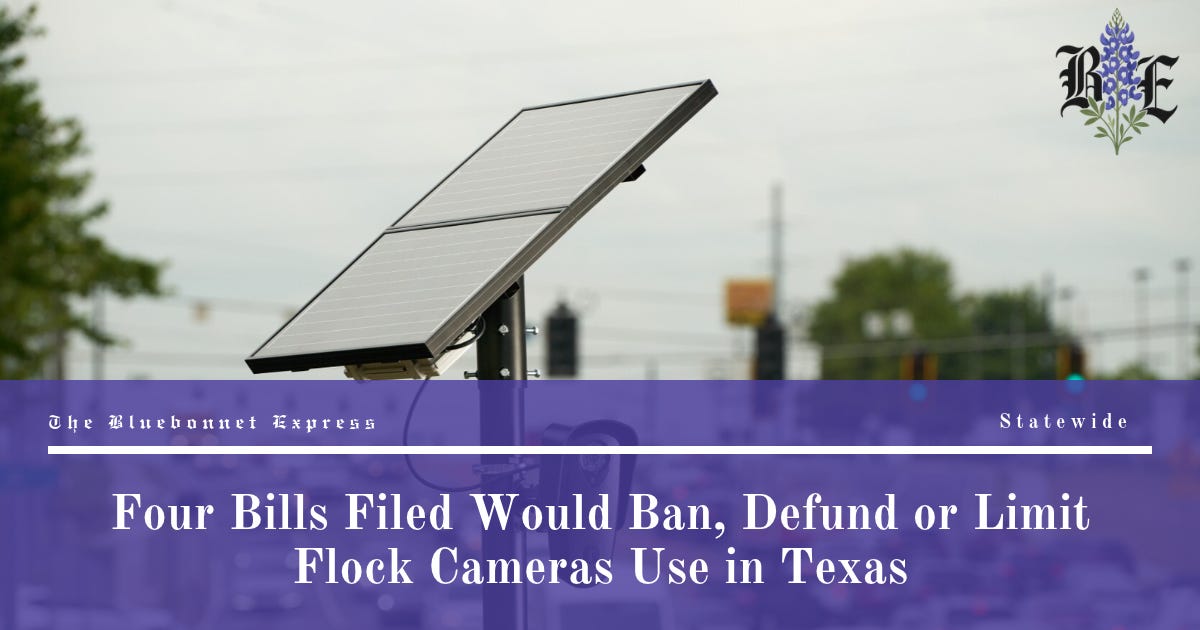
Lawmakers from both parties have filed bills for the 2027 legislative session that would ban, defund or put new limits on the roadside cameras that read Texas license plates.
Four bills were filed Nov. 9, the first day of bill filing for the 90th Legislature, according to Texas Legislature Online. Democrats wrote three of them and a Republican wrote the fourth. No single bill has authors from both parties. The Legislature convenes Jan. 12, 2027, and none of the bills has been referred to a committee.
The cameras, sold by Flock Safety and other companies, photograph passing vehicles and log the plate number, time and place. The Texas Tribune has reported that Flock’s software also records make, model, color, bumper stickers and dents, and that agencies can search other agencies’ camera networks.
The Bills
Senate Bill 232, by Sen. Carol Alvarado (D) SD-6 would bar money from the $1 annual fee on auto insurance policies from being used to buy, use or contract for license plate readers. Co-authors are Sen. Roland Gutierrez (D) SD-19, Sen. José Menéndez (D) SD-26, and Sen. Taylor Rehmet (D) SD-9. Alvarado wrote the 2023 law that created the fee to fight catalytic converter theft. She told the Tribune cameras were never discussed while that bill moved through the Legislature.
House Bill 331, by Rep. John Bucy (D) HD-136 would bar state agencies, cities, counties and their employees from using license plate readers. People harmed by a violation could sue for actual damages or $1,000, plus attorney’s fees.
House Bill 763, by Rep. Mary González (D) HD-75 would allow the cameras only for felony investigations, missing-person cases, stolen-vehicle recovery, unregistered or uninsured vehicles, tolls and parking, and secured areas. Agencies would have to delete plate data within 48 hours unless it is evidence in a pending case, under a warrant or held under a court-ordered preservation request. The bill would bar sharing the data with private companies and with the federal government. It would make redacted audit logs public records.
House Bill 847, by Rep. Brian Harrison (R) HD-10 would allow police to use the cameras only under a warrant or court order, and only to investigate violent offenses.
How the State Paid for Cameras
The Motor Vehicle Crime Prevention Authority, a state agency whose board is mostly appointed by the governor, used the insurance fee to help install at least 3,200 Flock cameras, the Tribune reported in August. The agency spent more than $30 million on them. Grants ranged from $7,000 for two cameras in Bellmead, near Waco, to almost $1.7 million for 201 cameras in Dallas. A $15.9 million contract helped the Texas Department of Public Safety put up 940 cameras.
Gov. Greg Abbott ordered state agencies on the night of Aug. 27 to stop funding Flock cameras, his spokesman confirmed to the Tribune. The order came as the Tribune was preparing to publish its investigation.
“To the extent that cities get any funding for those cameras, most of it comes from the federal government. To the extent any funding comes from Texas agencies, those agencies are clarifying that those funds cannot be used for Flock cameras,” spokesman Andrew Mahaleris said. Abbott later told Glenn Beck the cameras “are going to be required to be used responsibly if they’re used at all,” the Tribune reported. He also had the Texas Department of Transportation pause plate reader installations on state roads.
DPS paused new installations and kept about 900 cameras running, CBS Austin reported. It also limited searches of its data to agencies with signed agreements.
At least 14 cities and counties shut off more than 900 Flock cameras within a month of the freeze, the Tribune reported Sept. 24. Kendall County and the city of Robinson were among those that ended their contracts entirely.
What Supporters Say
Sheriffs and police chiefs, including several in rural counties, say the cameras help small departments cover ground they cannot patrol.
“We can’t be everywhere that the public may need us,” Lt. Michael Jurado of the Reeves County Sheriff’s Office told NewsWest 9. The department has 22 cameras along highways and near schools in the West Texas county. Jurado said they have helped deputies recover stolen vehicles, including ones taken in Odessa.
The Caldwell County Sheriff’s Office said cameras near Lytton Springs flagged two stolen vehicles on back-to-back days, Sept. 1 and 2, one reported in Bastrop County and one in Austin, according to the Lockhart Post-Register. Deputies recovered both and arrested both drivers.
Chambers County Sheriff Brian Hawthorne told Fox 26 in September that the county’s roughly 30 cameras have contributed to hundreds of arrests in two years. He said deputies used them in cases ranging from burglaries to homicides, and in the recovery of a 12-year-old child and the arrest of a kidnapping suspect from South Carolina. Hawthorne said the cameras do not photograph people inside vehicles or follow drivers continuously.
Brazos County Sheriff Wayne Dicky said a missing elderly man from his county was found after his car passed a camera in San Antonio. Dicky said the cameras do not use facial recognition and send alerts for plates on “hot lists” such as stolen vehicles, warrants, and Amber and Silver Alerts.
In the cities, Dallas police told CBS Texas the cameras helped solve more than a dozen murders this year. Douglas Griffith, president of the Houston Police Officers’ Union, told KPRC 2 the cameras are “one of the best tools that we have” and said he supports penalties for improper searches.
Flock spokeswoman Paris Lewbel said after the freeze that the cameras help officers “solve serious crimes, find missing people, recover stolen vehicles, and support safer communities.” The company said it supports “thoughtful legislation” with privacy and accountability guardrails.
What Critics Say
Critics point to warrantless searches, data sharing across state lines and cost.
The Tribune reported that DPS’s grant-funded network was searched on average once every four seconds in June by thousands of agencies across the country. Rep. Mitch Little (R) HD-65 told the Tribune in August: “The people in Lewisville, Texas have a reasonable expectation of privacy from police officers in Pampa, Texas, and yet they can observe all that data.”
The American Civil Liberties Union has cited a case in which a Texas officer searched Flock’s national database for a woman believed to have had a self-managed abortion. In August, the ACLU pointed to a database by the Institute for Justice listing more than 100 reported cases of license plate reader misuse, including stalking and wrongful stops. The same month, Flock cut its standard data retention to seven days from 30 and said it would require officers to enter a reason for each search. The ACLU said many of the changes would make little difference.
Cost has come up in small towns. The Lockhart City Council voted 6-1 in October 2025 against a $21,000-a-year contract for seven cameras, the Post-Register reported. Laredo will ask voters in a nonbinding May referendum whether to spend $1 million a year to keep 165 cameras that state grants had paid for, the Tribune reported.
Bucy told KPRC 2 the technology has been “a total violation of our privacy and security and liberty.” He also said he is open to talks with both parties on “really strict parameters.” Gov.-elect Gina Hinojosa, who opposed the cameras during her campaign, told the Tribune in September that the cameras “should be taken down and taxpayers should get their money back.”
Republicans and the Cameras
The 2026 Republican Party of Texas platform opposes government use of license plate readers in Plank 55. On Sept. 28, the party posted a resolution calling on the Legislature to ban every level of government from using or accessing them, with exceptions for warrants based on probable cause.
The Rusk County and Waller County Republican parties adopted resolutions calling for limits, Texas Scorecard reported. Little and Sen. Bob Hall (R) SD-2 said they would examine the cameras before the session, according to the same report. As of Nov. 12, Texas Legislature Online showed no license plate reader bill by either of them.
“I think this is an issue that goes beyond Republicans and Democrats,” Bucy told CBS Texas.
Harrison’s Record on the Issue
Harrison has filed a warrant bill in each of the last three sessions. TLO shows HB 3999 in 2023 and HB 961 in 2025, both with the same core language as this year’s HB 847. Each was referred to the House public safety committee and got no hearing.
HB 847 would require a warrant or court order before a law enforcement agency uses a plate reader. It would limit the images and data to investigations of violent offenses as defined in state law. Agencies would have to destroy data promptly unless it involves a vehicle or owner tied to such a case, could not hand data to outside parties for other purposes, and would have to post a policy and an annual report online. The report would list plates scanned and how many scans led to an arrest or prosecution.
“If you want to use these certain tools to collect data on innocent citizens, get a warrant,” Harrison told The Texan in 2024.
Harrison voted for Alvarado’s 2023 fee bill. “In a million years, I never could have even contemplated that this would be used to fund what is effectively warrantless surveillance,” he told the Tribune in August. He said he would not have voted for it had he known.
On Aug. 26, he posted on X: “I will (again) file legislation to FIGHT FLOCK CAMERAS in Texas!!!” On Aug. 28, after Abbott’s order, he posted that the freeze came “just days after I publicly and repeatedly demanded Texas stop funding FLOCK/ALPRs.” On Sept. 2, he posted a DPS email confirming the use of authority funds and wrote that the state had spent more than $11 million on 1,236 cameras, about $9,000 each by his math.
He has blamed House leadership for his bills stalling. On Sept. 5 he posted that “’Republican’ Speakers Phelan and Burrows have blocked them,” referring to former Speaker Dade Phelan (R) HD-21 and Speaker Dustin Burrows (R) HD-83. The Bluebonnet Express did not find a public response from either.
After the Nov. 3 general election, Harrison told CBS Texas that GOP support for the cameras “was a contributing factor to Republicans being defeated.” He said state Republican leaders had been “forcing Texas taxpayers to fund their own warrantless surveillance for many years.”
In August, Harrison and Little both told the Tribune they planned to file bills banning the cameras. HB 847, as filed, regulates them rather than banning them.
Sheriffs who back the cameras dispute the description of the system as tracking. “These images don’t prove anything. They’re just pieces to a puzzle,” Dicky said. Hawthorne compared the technology’s value to DNA and fingerprints.
What Happens Next
The bills cannot get hearings until the session begins Jan. 12. Bill filing runs through March 12, and the session must end by May 31, the Hamilton Brief reported.
Sources
SB 232 history and introduced text, Texas Legislature Online
HB 331 history and introduced text, Texas Legislature Online
HB 763 history and introduced text, Texas Legislature Online
HB 847 history and introduced text, Texas Legislature Online
HB 961 (2025) history and HB 3999 (2023) text, Texas Legislature Online
Lawmakers propose banning Flock camera grants by Texas agency, Texas Tribune, Nov. 12, 2026
Abbott blocks state agencies from spending money on Flock cameras, Texas Tribune, Aug. 28, 2026
How a $1 Texas insurance fee funded thousands of Flock cameras, Texas Tribune, Aug. 28, 2026
Texas funding freeze forces cities to address Flock use, Texas Tribune, Sept. 24, 2026
DPS pauses new Flock camera installations, CBS Austin
Texas lawmakers propose banning or restricting Flock cameras, CBS Texas
Ban or restrict? Three Texas bills target Flock and other license plate cameras, KPRC 2, Nov. 10, 2026
Reeves County Sheriff’s Office deploys camera to catch crime, NewsWest 9
Two stolen vehicles recovered in two days with help from Flock cameras, Lockhart Post-Register
Chambers County sheriff defends Flock cameras, plans to add more, Fox 26 Houston, Sept. 9, 2026
Brazos County sheriff defends use of Flock cameras, Government Technology
As public opposition to Flock grows, ACLU responds, ACLU, Aug. 13, 2026
How to fight deployment of Flock license plate readers, ACLU
Resolution reaffirming platform opposition to government use of Flock cameras, Republican Party of Texas, Sept. 28, 2026
Ban or warrant? Two Texas bills take aim at Flock cameras, Hamilton Brief, Nov. 11, 2026
Houston-area Flock camera scrutiny grows, Texas Scorecard
Automatic license plate readers’ use in Texas prompt privacy, legal concerns, The Texan
Rep. Brian Harrison on X: Aug. 26, Aug. 28, Sept. 2, Sept. 2 cost post, Sept. 5
Discussion about this post