HB 1181: Counties and Groundwater Districts Would Have to Approve Outside Aquifer Storage Wells
Rep. Stan Gerdes (R) HD-17 filed House Bill 1181. TCEQ could approve a water storage injection well outside the operator’s territorial limits or ETJ only with written consent from local officials.

Rep. Stan Gerdes (R) HD-17 filed House Bill 1181 (capitol.texas.gov) on Nov. 16, 2026. The bill would add a local consent step before the Texas Commission on Environmental Quality could approve some of the wells used to store water underground.
What the Bill Would Change
State law defines an aquifer storage and recovery project as one that injects water into a geologic formation so the project operator can later recover it for beneficial use. The wells that put the water in the ground are Class V injection wells, and the Water Code gives TCEQ exclusive jurisdiction over permitting them. The agency can authorize them by rule, under an individual permit or under a general permit.
HB 1181 would let TCEQ authorize a Class V well for an aquifer storage and recovery project located outside the territorial limits or extraterritorial jurisdiction of the project operator only with written consent from:
the commissioners court of each county where the project is wholly or partly located
each groundwater conservation district whose jurisdiction takes in all or part of the project
The bill does not define the operator’s territorial limits. It does not set a deadline for a county or district to answer a request, and it does not say what happens if one never acts.
What Local Officials Get Now
Under current law, an applicant for an individual permit has to mail notice of the application to any groundwater conservation district where the project’s wells will be located. The applicant also has to publish notice in a newspaper of general circulation in the county. For a general permit, TCEQ has to provide for public notice and comment by rule. Current law gives counties and districts no consent role.
When a project sits in a groundwater conservation district, the Water Code has TCEQ limit the water a project can recover to no more than the amount injected. The agency has to tighten that limit if it finds the injection would cause a loss of injected water or native groundwater, but it may not deny a permit because of that loss.
All wells in a single project must sit inside one continuous boundary on one parcel, or on adjacent parcels under common ownership, lease, joint operating agreement or contract. Lawmakers last amended the authorization section in 2025, through Senate Bills 863 and 2885.
Why It Reaches Rural Land
The consent rule would apply only to projects outside the operator’s territorial limits or extraterritorial jurisdiction. On that land, the local governments the bill names are the county commissioners court and, where one exists, the groundwater conservation district. Chapter 36 of the Water Code calls groundwater conservation districts “the state’s preferred method of groundwater management.”
Gerdes’ district covers Bastrop, Burleson, Caldwell, Lee and Milam counties, according to his Texas House member page.
Where It Stands
HB 1181 has been filed and has not been referred to a committee. It has no fiscal note yet. The 90th Legislature convenes Jan. 12, 2027. If the bill passes with a two thirds vote of each chamber, it would take effect right away. Otherwise it would take effect Sept. 1, 2027.
Gerdes is the only author listed on the bill.
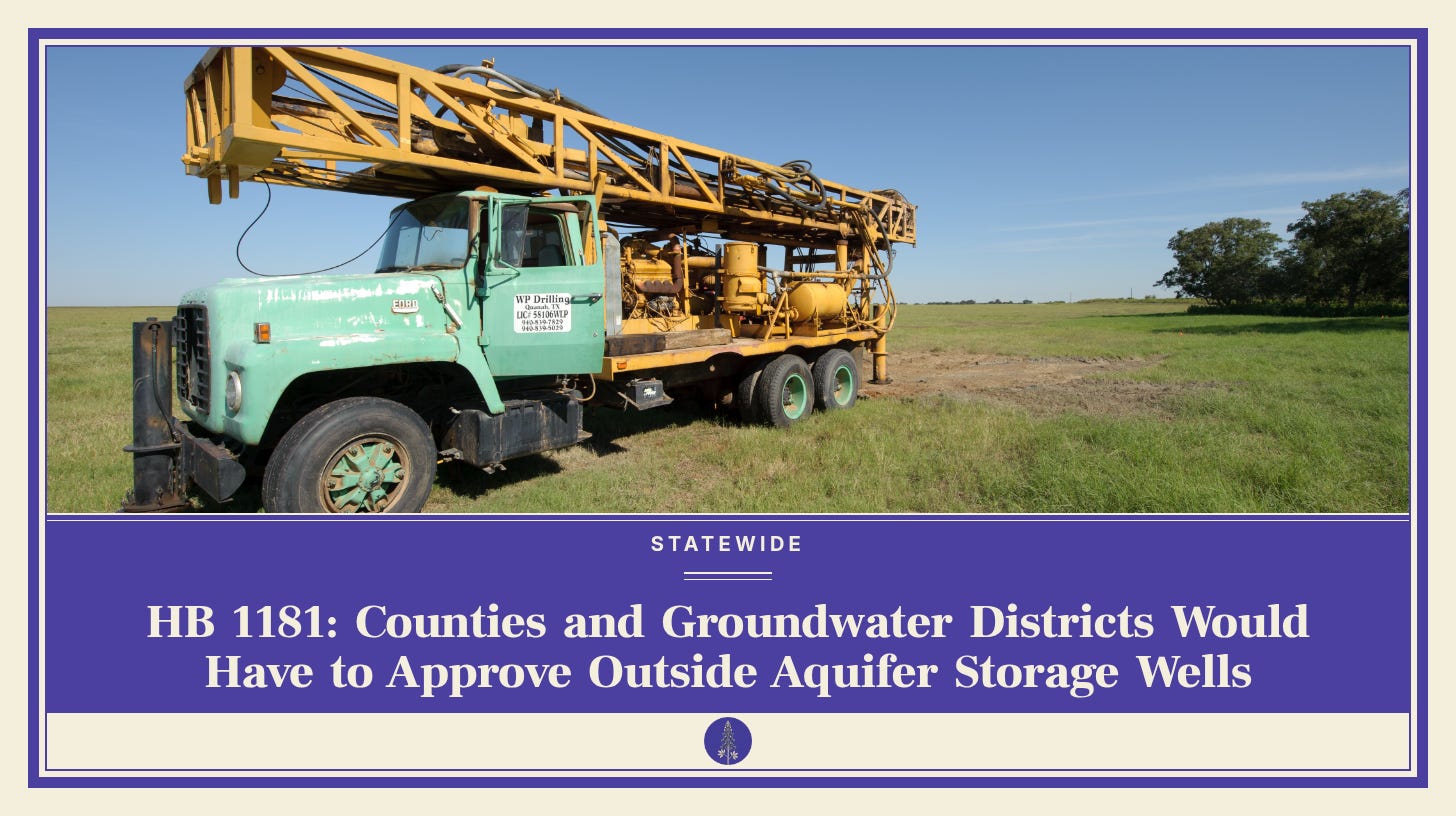
Header photo: A well drilling truck getting ready to drill a livestock water well at the Walking M Ranch in Baylor County, Sept. 28, 2010. USDA Natural Resources Conservation Service photo, public domain, via Wikimedia Commons. The rig is drilling a water supply well, which is a different kind of well than the injection wells the bill covers.

Sources
HB 1181 bill history, 90th Legislature: https://capitol.texas.gov/BillLookup/History.aspx?LegSess=90R&Bill=HB1181
HB 1181 bill text, as filed: https://capitol.texas.gov/tlodocs/90R/billtext/html/HB01181I.htm
Rep. Stan Gerdes, House District 17: https://house.texas.gov/members/member-page?district=17
Water Code Chapter 27, Subchapter G (aquifer storage and recovery): https://statutes.capitol.texas.gov/Docs/WA/htm/WA.27.htm
Water Code Chapter 36, Section 36.0015 (groundwater conservation districts): https://statutes.capitol.texas.gov/Docs/WA/htm/WA.36.htm
Government Code Section 301.001 (session start): https://statutes.capitol.texas.gov/Docs/GV/htm/GV.301.htm
Discussion about this post