SB 397: Kerr, Gillespie and Other Hill Country Counties Could Adopt Stormwater Rules and Charges
Sen. Judith Zaffirini (D) SD-21 filed Senate Bill 397. It would drop the 800,000 population floor in a state stormwater law and add counties in the Hill Country Priority Groundwater Management Area.

Sen. Judith Zaffirini (D) SD-21 filed Senate Bill 397 (capitol.texas.gov) on Nov. 16, 2026. The bill would widen the list of counties that can use a state law on stormwater management.
Who the Law Covers Now
Chapter 573 of the Local Government Code applies only to four kinds of local governments:
a county with a population of 2.8 million or more
a flood control district or authority whose boundaries match such a county
a county of more than 1.3 million people whose main source of drinking water is an underground aquifer
a county of 800,000 or more that contains a portion of the Edwards Aquifer
SB 397 would strike the 800,000 population requirement from the last group. It would also add any county located wholly or partly within the Hill Country Priority Groundwater Management Area, with no population minimum.
Which Counties Would Be Added
The Texas Commission on Environmental Quality lists the Hill Country Priority Groundwater Management Area as all of Bandera, Blanco, Gillespie, Kendall and Kerr counties and parts of Bexar, Comal, Hays and Travis counties.
U.S. Census Bureau estimates for July 2024 put each of those counties except Bexar and Travis well under 800,000 people:
Bandera, 22,830
Blanco, 13,358
Gillespie, 28,159
Kendall, 51,828
Kerr, 53,900
Comal, 201,628
Hays, 292,029
The bill and the chapter do not list which counties contain a portion of the Edwards Aquifer, so this story does not attempt that list.
What a County Could Do
A county covered by the chapter may take any necessary or proper action to comply with the stormwater permitting program under the national pollutant discharge elimination system, set up by Section 402 of the federal Water Pollution Control Act. The law lists these powers:
developing and carrying out controls to reduce pollutants discharged from county owned stormwater conveyances
developing, carrying out and enforcing stormwater guidelines, design criteria or rules to reduce pollutants discharged into those conveyances
helping residents manage used oil and toxic materials, including household hazardous waste collection events
providing educational tools and activities aimed at reducing pollutants in stormwater
assessing reasonable charges to fund the stormwater permitting program as needed to meet federal or state requirements
A county may not assess a charge against property that is exempt from property tax or that another entity already assesses for the same purpose. A person who violates a county rule or order under the chapter is liable for a civil penalty of up to $1,000 for each violation, and each day a violation continues counts as a separate violation. The county can sue in district court to stop a violation or collect the penalty.
SB 397 does not change those powers. It changes only which counties have them.
Where It Stands
SB 397 has been filed and has not been referred to a committee. It has no fiscal note yet. The 90th Legislature convenes Jan. 12, 2027. If the bill passes with a two thirds vote of each chamber, it would take effect right away. Otherwise it would take effect Sept. 1, 2027.
Zaffirini is the only author listed on the bill. Her Senate page says District 21 covers 16 counties, from Laredo to Starr County and north to Travis and Hays counties.
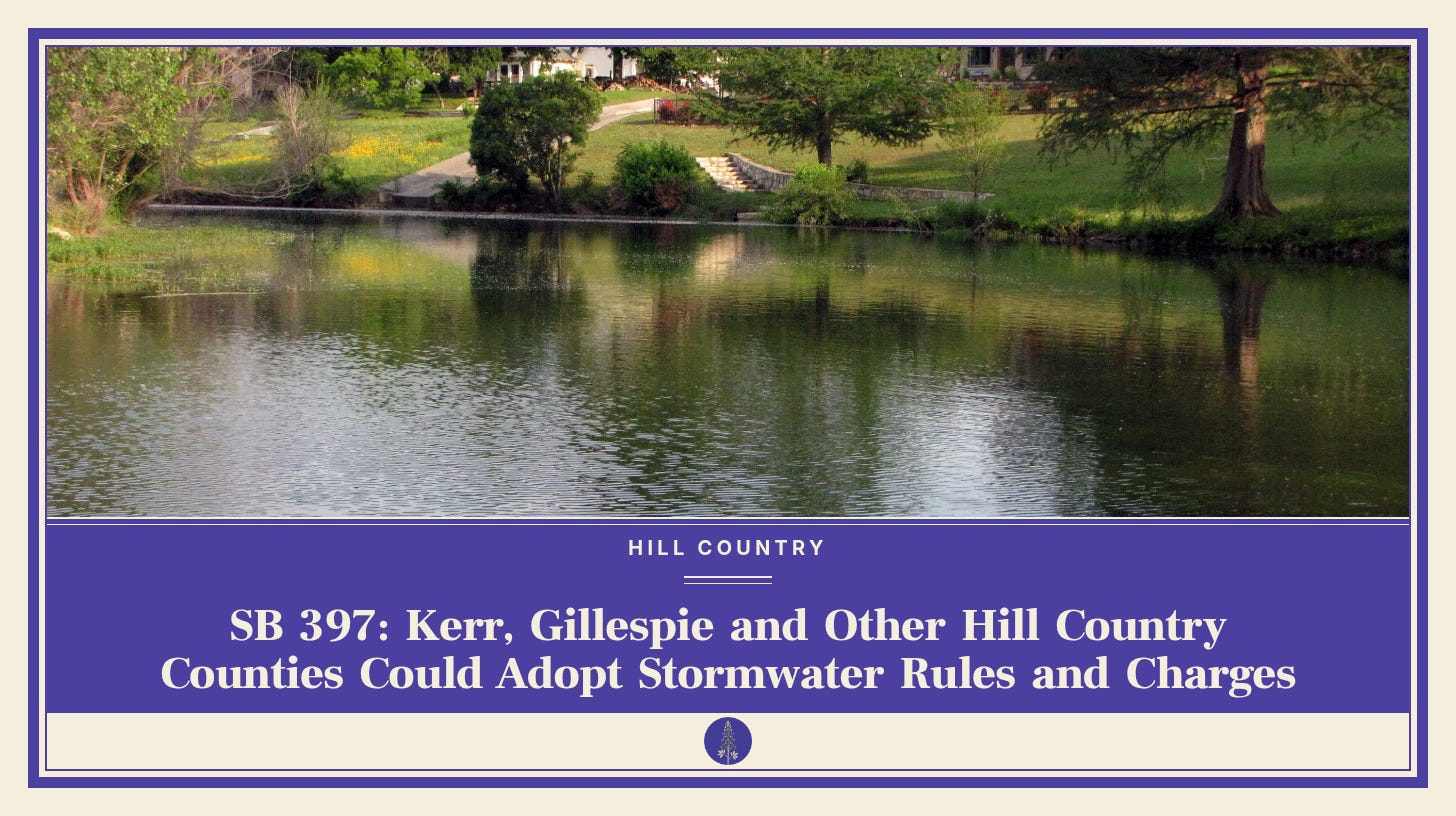
Header photo: Cibolo Creek running past homes in Boerne, Kendall County, April 30, 2010. Photo by Don Baird, CC BY-SA 2.0, via Wikimedia Commons.

Sources
SB 397 bill history, 90th Legislature: https://capitol.texas.gov/BillLookup/History.aspx?LegSess=90R&Bill=SB397
SB 397 bill text, as filed: https://capitol.texas.gov/tlodocs/90R/billtext/html/SB00397I.htm
Sen. Judith Zaffirini, Senate District 21: https://senate.texas.gov/member.php?d=21
Local Government Code Chapter 573 (county stormwater management): https://statutes.capitol.texas.gov/Docs/LG/htm/LG.573.htm
TCEQ, What Is a Priority Groundwater Management Area: https://www.tceq.texas.gov/downloads/groundwater/maps/pgma-text.pdf
U.S. Census Bureau, Texas population estimates, 2020 to 2024: https://www2.census.gov/programs-surveys/popest/datasets/2020-2024/cities/totals/sub-est2024_48.csv
Government Code Section 301.001 (session start): https://statutes.capitol.texas.gov/Docs/GV/htm/GV.301.htm
Discussion about this post