SB 1150: Inactive Wells New Plugging Rules
Public Hearing and Comment Deadline Today

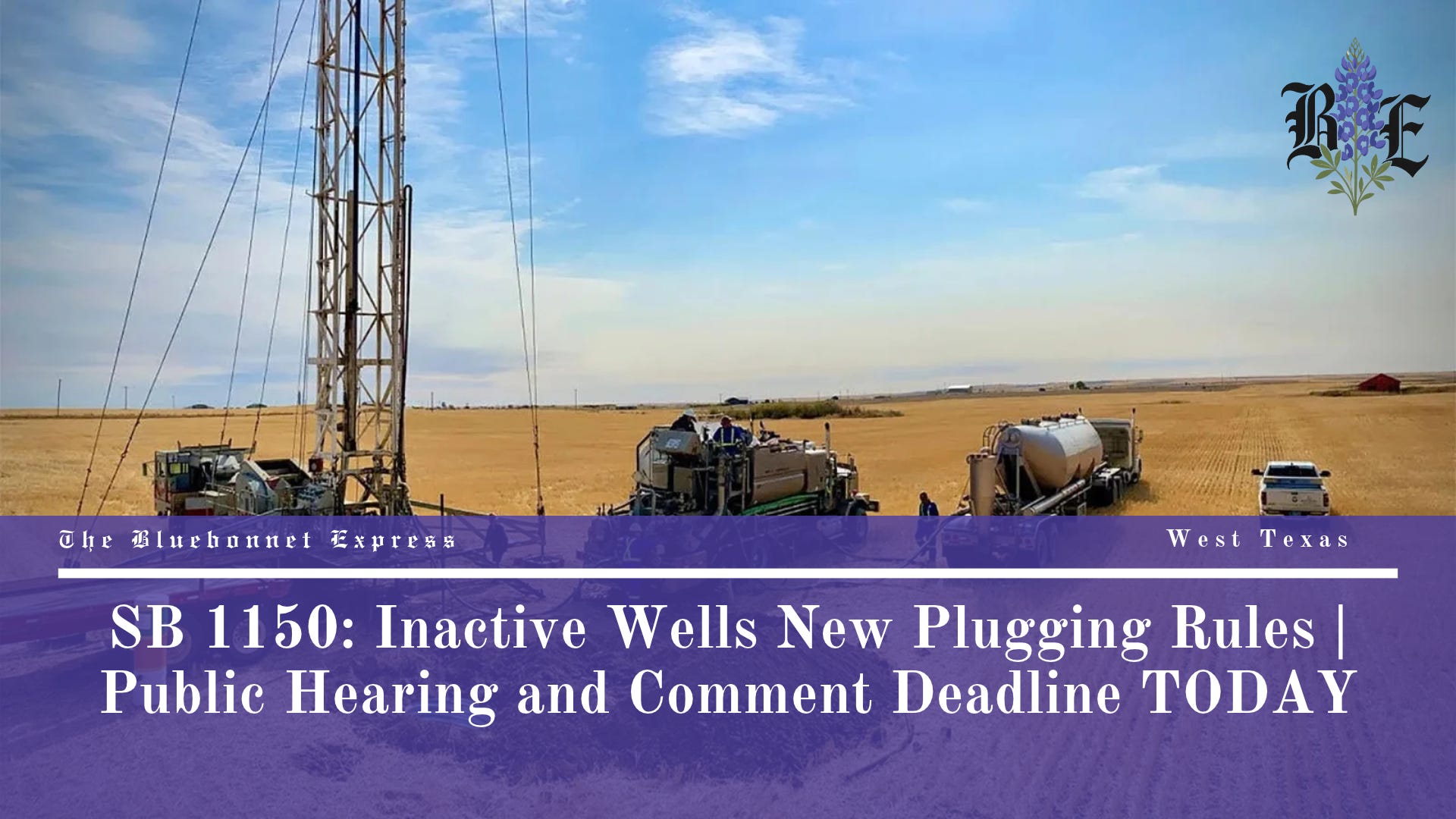
The Railroad Commission of Texas has proposed rule changes that spell out how oil and gas operators can keep long-idle wells unplugged under a 2025 state law, and the agency will hear public comments on them Friday, Nov. 20.
The proposal amends two sections of the commission’s oil and gas rules, 16 Texas Administrative Code §3.15 and §3.58. It carries out SB 1150 (capitol.texas.gov), which the Legislature passed in 2025 and the governor signed June 20, 2025, according to Texas Legislature Online. The commission approved publishing the proposal at its Oct. 6 conference, and it appeared in the Oct. 23 issue of the Texas Register.
What the Law Requires
SB 1150 was written by Mayes Middleton (R), then the senator for SD-11. Its House sponsors included Rep. Drew Darby (R) HD-72 and Rep. Eddie Morales (D) HD-74. The enrolled bill passed the Senate 30-1 and the House 128-0, according to the certification on the enrolled text.
The law targets what the commission now calls “15/25 wells.” Those are wells that have been inactive for more than 15 years and were completed more than 25 years before the operator asks for more time. Under the law, an operator can no longer get a plugging extension for one of those wells through the usual process. The commission can grant an extension only if:
the operator’s history of returning inactive wells to production justifies it;
the operator shows financial hardship;
the well is in a commission-approved compliance plan in which the operator commits to plug the well or put it back to use by Sept. 1, 2042; or
the operator files an individual performance bond for at least the full cost of plugging the well, and the bond stays with the well for its lifetime even if the operator changes.
The law also requires both operators in a sale or transfer of an inactive well to sign a joint statement that the well is in compliance, that the transfer was made in good faith and that the new operator will keep it in compliance. Extensions based on an operator’s track record or financial hardship do not carry over to a new operator.
Operators must file a yearly report with fluid level or hydraulic pressure test results for each inactive well whose completion report was filed at least 15 years earlier. The commission must send the governor, lieutenant governor and Legislature a yearly report on inactive wells by Dec. 1, with the first one due Dec. 1, 2026.
The bill directs the commission to adopt its rules by Dec. 31, 2026, and says those rules take effect Sept. 1, 2027. The section with the new plugging limits also takes effect Sept. 1, 2027, according to the bill’s effective-date remarks on Texas Legislature Online.
What the Proposed Rules Would Change
According to the proposal published in the Texas Register, the rules would:
Add definitions for “15/25 well” and for the “full cost calculation for plugging an inactive well.” The full cost would include third-party costs such as extra work tied to the wellbore, road building or brush clearing to reach the site, a location in a hydrogen sulfide field, and commission staff time to oversee the plugging. It would not include the operator’s own overhead.
Lower the age at which inactive wells must pass a fluid level or hydraulic pressure test from more than 25 years to more than 15 years. A hydraulic pressure test would still be good for up to five years, but the results would have to be sent to the commission every year.
Limit the current extension process to inactive land wells that are not 15/25 wells, and set up a separate application for 15/25 wells. Those extensions would apply only to land wells, would last one year and would be renewed along with the operator’s yearly organization report.
Require operators applying for a 15/25 extension to identify the well’s nonoperators by name, address and contact information, using commission filings, current county tax rolls and other readily available sources.
The proposal sets out tests for each of the four kinds of extension.
Track record. An operator with no more than 10 inactive wells would qualify by restoring one well to active operation in the past year. An operator with more than 10 would need to restore at least 10% of its inactive wells in the past year.
Financial hardship. The operator would file CPA-certified financial statements covering three fiscal years and a signed attestation. Approval would be warranted under any one of several tests, including when the full cost of plugging all of the operator’s 15/25 wells is more than its total annual revenue or total assets, or when paying one-fifteenth of that cost would push the operator into bankruptcy or default on a major debt.
Compliance plan. The plan would have to schedule plugging or restoring at least the operator’s total number of 15/25 wells divided by the years left until Sept. 1, 2042, each year. Operators would be expected to rank wells by age, length of inactivity and any hazard to public health, safety or the environment.
Bond. The bond would have to equal the full plugging cost, cover the well for its lifetime regardless of operator, and be issued by a third-party bank authorized to do business in Texas.
The commission would be required to deny an application in several cases, including when the well poses potential hazards to public health and safety or the environment, when the operator has been penalized for false filings, when the hardship is the operator’s own fault, or when the operator has a past serious safety or pollution violation. Operators could ask for a hearing within 30 days of a denial.
Cost and Local Effect
David Lindley, director of the commission’s Oil and Gas Division, estimated in the proposal that carrying out SB 1150 will cost the agency $6,036,855 in the first year after the rules take effect and between about $10.5 million and $14.9 million in each of years three through five. Those estimates cover new technology systems, 86 full-time employees, vehicles and equipment. At the time of the proposal, no general revenue money had been appropriated to the commission for the work, the proposal says.
Lindley wrote that the expected public benefit is fewer wells sitting idle indefinitely and ending up on the orphaned well list, where plugging becomes the state’s job. The commission determined the rules would have no adverse economic effect on rural communities, small businesses or micro-businesses. It said the rules may help rural communities through more work in the well plugging industry and possibly higher property values. The commission also said the extension options are voluntary and that an operator’s duty to plug inactive wells has not changed.
How Many Wells Are Idle
The commission’s monthly “Wells Monitored by the Railroad Commission” report counted 157,815 inactive oil and gas wells in Texas as of Sept. 30, 2026, out of 431,161 wells statewide. The proposal does not give a count of 15/25 wells, and The Bluebonnet Express did not find one published by the commission. The agency’s monthly Inactive Well Aging Report lists every inactive well, with its county, district, shut-in date and original completion date, and was last updated with data as of Nov. 10. Its online query lets anyone search the list by operator, district, field or county.
More than 330 comment files had been posted on the commission’s comments page as of a Nov. 10 update, including two batches of bulk comments.
How to Comment
The commission’s proposed rules page and its comments page list the end of the comment period as 5 p.m. Friday, Nov. 20, 2026. The notice published in the Texas Register on Oct. 23, and the commission’s plain-language summary of the rule, list 5 p.m. Friday, Nov. 13, 2026. The Bluebonnet Express did not find a later Texas Register notice changing the date. People who want to be sure their comments count can file by the earlier date or confirm the deadline with the commission’s Rules Coordinator.
Comments can be sent three ways, according to the Texas Register notice:
Online: rrc.texas.gov/general-counsel/rules/comment-form-for-proposed-rulemakings. Choose “Amend §§3.15 and 3.58 (Senate Bill 1150).” The form is limited to about eight pages of text.
Email: rulescoordinator@rrc.texas.gov
Mail: Rules Coordinator, Office of General Counsel, Railroad Commission of Texas, P.O. Box 12967, Austin, Texas 78711-2967
The commission posts comments online. Anyone who doesn’t see a comment posted within three business days can call the Office of General Counsel at 512-463-7149. Questions about the rule go to Lindley at 512-463-6217.
How to Attend the Hearing
The hearing starts at 10 a.m. Friday, Nov. 20, at the commission’s Austin headquarters in Room 1.111 of the William B. Travis Building, 1701 N. Congress Ave., and online through Zoom, according to the commission’s Nov. 6 announcement. People attending in person will speak first and can sign up when they arrive.
People who want to speak by Zoom must register by 5 p.m. Thursday, Nov. 19, by emailing rulescoordinator@rrc.texas.gov with a request to give verbal comment, their name, title and affiliation, and an email address and daytime phone number. The commission’s announcement does not post a public Zoom link. Those who only want to watch can stream the hearing at adminmonitor.com/tx/rrc.
Sidebar: Carbon dioxide storage well rules close Nov. 23
The commission is also taking comments on changes to its Chapter 5 rules for Class VI wells, which are used to inject carbon dioxide deep underground for storage. The proposal ran in the same Oct. 23 Texas Register issue, and comments close at 5 p.m. Monday, Nov. 23, 2026, according to the Texas Register notice and the commission’s proposed rules page.
The U.S. Environmental Protection Agency gave the commission authority over Class VI wells in Texas effective Dec. 15, 2025, the proposal says. Among other changes, the amendments would separate public meetings, where interested persons can comment on a draft permit, from contested case hearings for affected persons who protest a permit. They would let operators ask for exceptions on certain casing and packer placement requirements, require applicants to work with state and local emergency officials on emergency response plans, and add escrow accounts and third-party insurance as ways to meet financial responsibility requirements.
Leslie Savage, the Oil and Gas Division’s chief geologist, determined in the proposal that the changes would not add costs for operators beyond what federal rules already require. The notice says the commission will hold a virtual public hearing within the comment period and post details on its website at least 10 business days ahead. The Bluebonnet Express did not find a hearing date posted as of Nov. 13. Comments go through the same online form, email address and P.O. box listed above. Questions go to Savage at 512-463-7308.
Sources
SB 1150 (89R) history, Texas Legislature Online: https://capitol.texas.gov/BillLookup/History.aspx?LegSess=89R&Bill=SB1150
SB 1150 (89R) enrolled text: https://capitol.texas.gov/tlodocs/89R/billtext/html/SB01150F.htm
Railroad Commission proposed rules page: https://www.rrc.texas.gov/general-counsel/rules/proposed-rules/
RRC proposal memo and text, §§3.15 and 3.58 (Oct. 6, 2026): https://www.rrc.texas.gov/media/teiotqns/prop-amend-315-and-358-sb1150-100626-sign.pdf
Texas Register, Oct. 23, 2026, Proposed Rules, Title 16: https://www.sos.texas.gov/texreg/archive/October232026/Proposed%20Rules/16.ECONOMIC%20REGULATION.html
RRC plain-language summary, §§3.15 and 3.58: https://www.rrc.texas.gov/media/mtalkn0t/pls-english-prop-amend-315-and-358-100626.pdf
RRC hearing announcement (Nov. 6, 2026): https://www.rrc.texas.gov/news/rrc-to-host-public-hearing-on-proposed-sb-1150-rule-amendments/
RRC hearings calendar: https://www.rrc.texas.gov/hearings/hearings-calendar/
RRC comment form: https://www.rrc.texas.gov/general-counsel/rules/comment-form-for-proposed-rulemakings/
RRC comments received, SB 1150 rules: https://www.rrc.texas.gov/general-counsel/rules/proposed-rules/comments-received/comments-received-for-315-and-358-sb1150/
RRC proposal, Chapter 5 Class VI amendments (Oct. 6, 2026): https://www.rrc.texas.gov/media/uxckekh2/prop-amend-chap-5-class-vi-100626-sign.pdf
RRC, Wells Monitored by the Railroad Commission, as of Sept. 30, 2026: https://www.rrc.texas.gov/media/xtanopxg/september-2026.pdf
RRC Inactive Well Aging Report (IWAR) page: https://www.rrc.texas.gov/oil-and-gas/compliance-enforcement/hb-2259hb-3134-inactive-well-requirements/inactive-well-aging-report-iwar/
Discussion about this post