Senate Bill 297 Would Send a One-Time $1,500 Payment to Each Qualified Texas Household
Sen. Roland Gutierrez, D-Senate District 19, filed the bill Nov. 9 to carry out a campaign pledge by Gov.-elect Gina Hinojosa, drawing $17 billion from the state’s rainy day fund

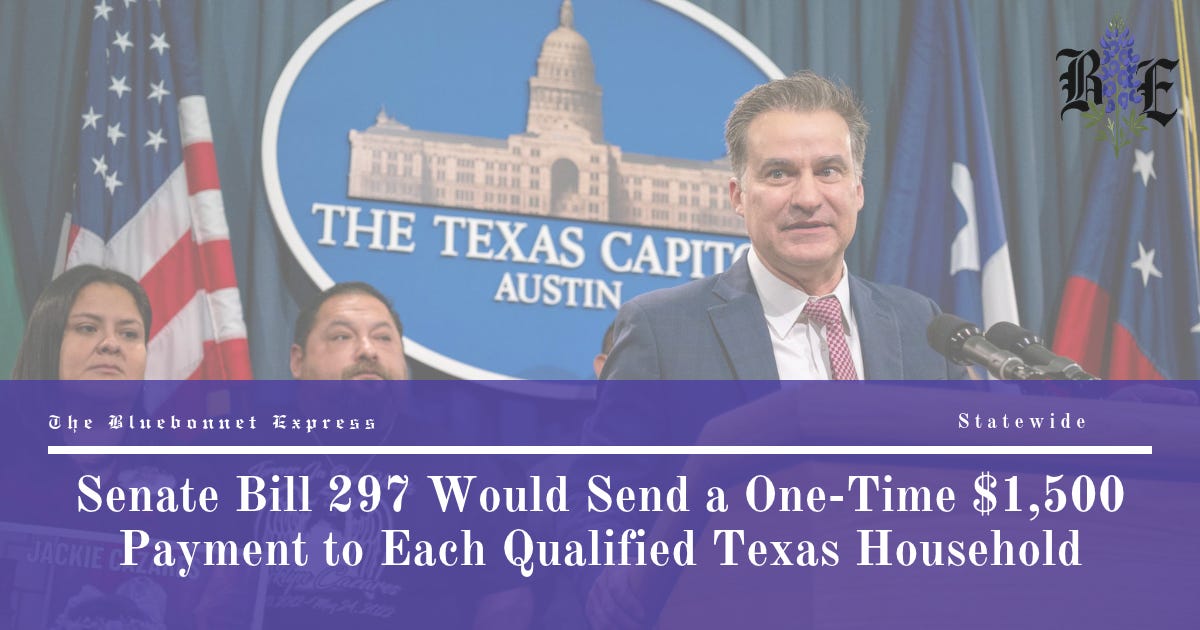
Sen. Roland Gutierrez, D-Senate District 19, filed Senate Bill 297 on Nov. 9, proposing a one-time $1,500 payment to each qualified Texas household. The Texas Tribune reported that the bill is meant to carry out a campaign pledge by Gov.-elect Gina Hinojosa of a one-time payment as cost-of-living relief. Texas Legislature Online records it as filed by Gutierrez, with no committee referral yet.
The introduced text defines a household as one or more people occupying a dwelling unit as their usual place of residence, related or not, including a person who lives alone. A qualified household would need a usual place of residence in Texas on Jan. 1, 2027, and be represented by a person at least 18 on that date, or an emancipated minor. Each qualified household would receive one $1,500 payment, with no increase for additional members.
The comptroller of public accounts would administer the program and could use information lawfully available to that office or another state agency to identify eligible households, but could not deny a payment solely because a household is missing from an existing government database. Residents could also apply, proving usual residence with a lease, utility record, school record, government correspondence, a sworn declaration, “or other reasonably reliable evidence.” Applications would have to be accepted by mail and in person, as well as electronically. Payments could go out by electronic funds transfer, check, or another secure method the recipient chooses. The comptroller would make reasonable efforts to pay verified households by Dec. 31, 2027; applications could be filed through Dec. 31, 2028.
The bill would apply statewide, with no different rules by county or region and no county-by-county household count. The comptroller would have to adopt rules for people experiencing homelessness, residents of group quarters, and other households without a conventional street address. Eligibility could not be based on income, homeownership, property-tax liability, employment, public benefits, or whether members filed a tax return. The introduced text does not mention U.S. citizenship as a condition, the Tribune noted.
The bill would appropriate $17 billion from the Economic Stabilization Fund, the state’s rainy day fund, for the payments and administration. The comptroller’s Annual Cash Report for fiscal 2026 put the fund at $27.5 billion as of Aug. 31, 2026. Spending from the fund would require a two-thirds vote of the members present in each house, under Section 49-g(m), Article III, of the Texas Constitution. The Tribune reported that, in the Republican-majority Senate, that would take at least nine Republican votes. No more than 1 percent of the appropriation could go to administrative costs. The Tribune reported that would leave a shortfall of at least $400 million if the plan reached 11.6 million households. If funds proved insufficient, the comptroller would have to report the shortfall to the governor, lieutenant governor, House speaker, and Legislative Budget Board, and could not spend more than appropriated.
Section 51, Article III, of the Texas Constitution says the Legislature has no power to grant public money to individuals, provided the section is not construed “so as to prevent the grant of aid in cases of public calamity.” The bill declares a statewide household affordability emergency — which it ties to sustained cost increases for housing, electricity, food, transportation, insurance, and other necessities — to be a public calamity under that section. The Tribune reported that it is unclear whether that declaration would hold up legally.
John Diamond, senior director of the Center for Public Finance at Rice University’s Baker Institute for Public Policy, told the Tribune the checks could add to inflation by increasing demand and prices. He called $17 billion “not a massive amount” relative to the state’s roughly $2.9 trillion economy, “but it’s still enough to create some pricing pressures.” In an August interview cited by the Tribune, Gov.-elect Hinojosa said economists who reviewed the plan believe a state-level payment is too small to have the same effect as federal stimulus checks.
What Happens Next
SB 297 is not law. The 90th Legislature convenes Jan. 12, 2027, and the bill awaits a committee referral. If it received a two-thirds vote of all members elected to each house, it would take effect immediately; otherwise it would take effect Sept. 1, 2027. The comptroller would then have 30 days to adopt emergency rules and open an application method.
Sources
State of Texas Annual Cash Report, Fiscal 2026, Texas Comptroller of Public Accounts
Joshua Fechter, Bill filed to give every Texas household $1,500, a Gov.-elect Gina Hinojosa campaign promise, Texas Tribune via KSAT, updated Nov. 11, 2026, at 4:00 a.m. Central
Dates of Interest, Texas Legislative Council (90th Regular Session convenes Jan. 12, 2027)
Discussion about this post