Senate Bill Ties Data Center Tax Breaks and Grid Hookups to Water Rules
SB 338, carrying 16 authors, would require yearly water reports from large data centers and limit local tax abatements for them

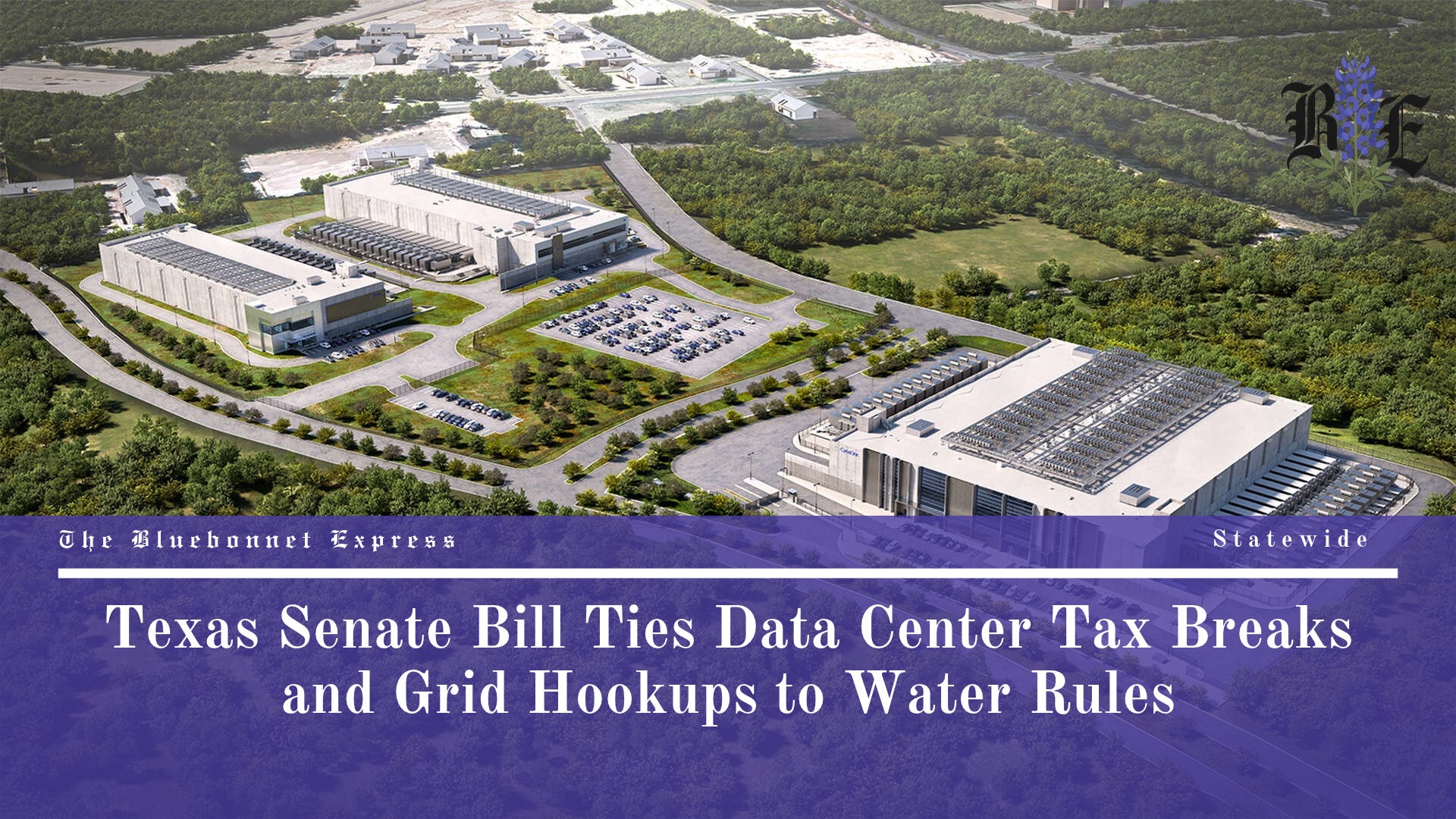
Large data centers in Texas would be limited to closed-loop, dry and other approved low-water cooling systems, and would have to report their cooling water use each year, under a Senate bill filed Thursday with 16 authors listed.
Senate Bill 338 was filed Nov. 12 by Sen. Charles Perry (R) SD-28 of Lubbock. Its caption reads "relating to data centers."
Texas Legislature Online lists 15 other lawmakers as authors with Perry: Sen. Donna Campbell (R) SD-25, Sen.-elect David Cook (R) SD-22, Sen. Pete Flores (R) SD-24, Sen. Brent Hagenbuch (R) SD-30, Sen. Bob Hall (R) SD-2, Sen. Adam Hinojosa (R) SD-27, Sen. Juan "Chuy" Hinojosa (D) SD-20, Sen. Joan Huffman (R) SD-17, Sen. Bryan Hughes (R) SD-1, Sen. Lois Kolkhorst (R) SD-18, Sen. Brett Ligon (R) SD-4, Sen. Tan Parker (R) SD-12, Sen.-elect Dennis Paul (R) SD-11, Sen. Angela Paxton (R) SD-8 and Sen. Kevin Sparks (R) SD-31. Cook and Paul serve in the Texas House and won those Senate seats Nov. 3, according to unofficial state election results.
The bill covers sites with one or more buildings that, alone or together, take up at least 100,000 square feet and are built or adapted to house servers and related equipment for processing, storing and distributing data.
Cooling and water reports
The Public Utility Commission would have to require data centers to use one of four kinds of cooling, or a mix of them, before they connect to the ERCOT grid. The options are a closed-cycle system that reuses the same water, a dry system that uses no water, a system using only desalinated seawater, desalinated brackish water or water from oil and gas waste fluid, or a system the commission finds uses less water than a closed-cycle system. The rule would also cover any power generation built at the data center site.
Before connecting, a data center would file an estimate of its yearly cooling water needs and where that water would come from. After connecting, it would report each year how much water it used for cooling and the sources. The PUC would send those reports to the Texas Water Development Board at least once a year and consult the board on the reporting forms.
Power connections
Under the bill, the PUC would bar electric cooperatives, city-owned utilities and transmission and distribution utilities from connecting a data center that does not meet the cooling and filing rules. Those utilities would have to disconnect a site that uses another cooling method while connected or fails to file its yearly report.
Data centers that are large electric customers already covered by the state's large-load interconnection standards would have to register with the PUC. The commission could also set limits on noise and light from a site and require buildings to sit a minimum distance from the property line.
The PUC's cooling and reporting rules would apply only to data centers that connect to the grid on or after the bill's effective date.
Tax breaks
The bill adds conditions to the local and state tax deals data centers can receive.
A city tax abatement could exempt no more than 50% of the value that would otherwise be eligible for abatement in any year. Abatement agreements, including those made by counties and other taxing units, would have to require the owner to follow the cooling and water reporting rules, pay to clean up environmental damage to the property, and give the local government a permanent, recorded restriction on the land barring other cooling methods. If the owner breaks the terms, the bill says the local government could end the agreement and would recover the lost tax revenue with interest. Cities could not make economic development loans or grants for a data center without an agreement that meets the same requirements.
Under the state's school tax limitation program known as JETI, current law sets the taxable value of a project at 50% of market value, or 25% in a qualified opportunity zone. SB 338 would set a data center's taxable value at "not more than 50 percent" of market value. JETI agreements with data centers would carry the same cooling, reporting and cleanup terms, and the governor or school district could end an agreement if a data center breaks any of them. The tax changes would apply only to agreements signed after the bill takes effect.
Construction permits
The bill also involves the Texas Commission on Environmental Quality. A data center seeking coverage under the state's general stormwater permit for construction would have to attest that it meets or will meet the PUC's rules. TCEQ would have to issue an emergency order halting construction if it finds a data center does not or will not comply, and after a hearing it would have to deny or suspend the site's permit authorization.
What it means outside the cities
The bill names electric cooperatives among the utilities that would enforce the cooling rules, and it sets terms for tax deals that counties and school districts strike with data centers. The yearly water reports would go to the state agency that runs water planning.
Coverage and comments
KLTV in Tyler reported the filing Nov. 12 and said, "Fifteen Republicans and one Democrat have signed on as authors." KBTX in Bryan reported that 16 filed bills, 12 in the House and four in the Senate, deal with data centers.
Perry chairs the Senate Committee on Water, Agriculture and Rural Affairs. At a Sept. 1 interim hearing on data center water use, he said, "There's no reason you should waste water on an evaporative cooling system. I hope that's loud and clear. That won't be allowed coming out of next session, I promise," according to The Texas Dispatch. The same report quoted him saying the 1.3 billion gallons reported by 81 operating facilities in a PUC survey is "not that behemoth that I think public perception is, but it's going to grow."
The Bluebonnet Express found no statement from Perry's office or from data center industry groups about SB 338 as of Friday morning.
SB 338 would take effect Sept. 1, 2027. It is not law. The 90th Legislature convenes Jan. 12, 2027, and lawmakers can file bills through March 12. Many filed bills never get a committee hearing or a vote.
Discussion about this post