Virdell Refiles Bill Adding a Defense for Displaying a Weapon in Self-Defense
The House passed the same language 119-18 last session, and the Senate did not vote on it. On X, Virdell said he is grateful to refile it.

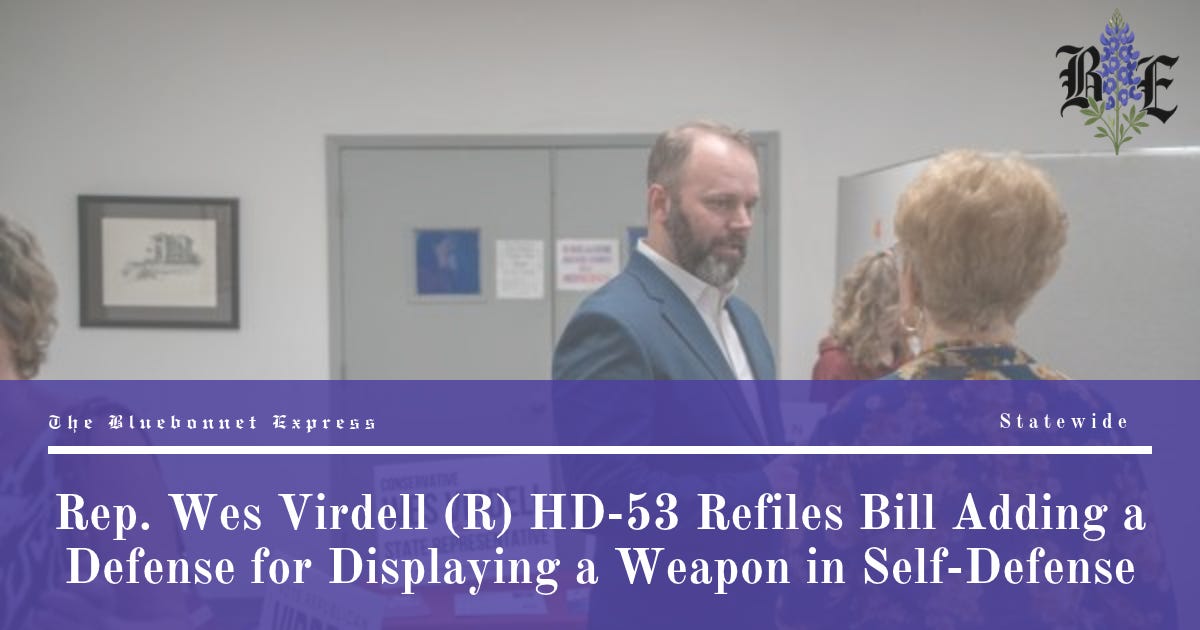
Rep. Wes Virdell (R) HD-53 filed House Bill 1024 on Nov. 10, according to Texas Legislature Online. The bill would add a defense to prosecution for aggravated assault when a person threatens death or serious bodily injury by exhibiting a deadly weapon in circumstances justified under Texas self-defense law. Virdell is the only author so far. The caption reads, “Relating to a defense to prosecution for the offense of aggravated assault.” The introduced text carries drafting code 90R238 JCG-F. If the bill becomes law, it would apply only to offenses committed on or after Sept. 1, 2027. The Legislature convenes Jan. 12, 2027.
Virdell’s Response
On Nov. 10, Holly Hansen posted on X that Virdell had filed a bill “making it a defense to prosecution of aggravated assault if the was ‘immediately necessary to defend the actor against another’s use or attempted use of unlawful force or deadly force.’” Virdell quoted that post at 4:39 p.m. Central the same day and wrote, “We should have passed this last year, but I am grateful to refile this year.”


He described the earlier version in a May 19, 2025, reply on X. “In regards to the brandishing bill, the purpose is about making it extremely clear to the judicial system that brandishing isn’t a crime in the act of self defense,” he wrote. “It is very important to pass this bill because liberal cities and counties don’t respect your right to self defense and they will take current law out of context if they can.”
What the Bill Would Do
HB 1024 would add Subsection (a-1) to Section 22.02 of the Penal Code as a defense to prosecution under Section 22.02(a)(2), which makes an assault aggravated when the actor “uses or exhibits a deadly weapon during the commission of the assault.” The defense would apply if the actor threatened to cause death or serious bodily injury by exhibiting a deadly weapon, the threat would be justified under Chapter 9, and the actor reasonably believed that creating an apprehension that the actor would use the weapon was immediately necessary to defend against another person’s use or attempted use of unlawful force or deadly force.
The new defense would not apply to a charge under Section 22.02(a)(1) for causing serious bodily injury, or to other offenses that can arise from displaying a firearm, such as deadly conduct under Section 22.05.
Under Section 22.01, an assault can be committed by intentionally or knowingly threatening another person with imminent bodily injury, even if no one is injured. Using or exhibiting a deadly weapon during that assault makes the offense aggravated assault, generally a second-degree felony.
Chapter 9 already addresses threats made with a weapon. Section 9.04 says the threat of force is justified when the use of force is justified under that chapter, and that a threat to cause death or serious bodily injury “by the production of a weapon or otherwise, as long as the actor’s purpose is limited to creating an apprehension that he will use deadly force if necessary, does not constitute the use of deadly force.” Sections 9.31 and 9.32 set the standards for force and deadly force in self-defense.
Section 9.02 already states, “It is a defense to prosecution that the conduct in question is justified under this chapter.” Under Section 2.03, a prosecutor is not required to negate a defense in the charging instrument. The issue goes to the jury only if evidence supporting the defense is admitted, and a reasonable doubt on that issue requires acquittal. HB 1024 would write a more specific defense into the aggravated assault statute, still under those procedures. It would not be an exception under Section 2.02, which would require the prosecutor to negate the issue in the accusation.
The House Criminal Jurisprudence Committee’s 2025 analysis of last session’s bill said Virdell had told the committee that Texas law does not define “brandishing” and that “justification for such an action may not be as clear in all cases.” People who display or draw a firearm may face charges such as unlawful carrying of a weapon, deadly conduct or aggravated assault “if the conduct is deemed unlawful,” the analysis said.
Last Session
The operative language in HB 1024 matches House Bill 2458, which Virdell filed on Feb. 5, 2025. Rep. Ryan Guillen (R) HD-31 and Rep. Carrie Isaac (R) HD-73 joined as joint authors, along with 20 co-authors. The House Criminal Jurisprudence Committee voted 7-1 to report it favorably.
At an April 15, 2025, hearing, Richard Hayes testified for the bill for himself and Gun Owners of America. The Texas State Rifle Association, the National Rifle Association and the True Texas Project registered in support but did not testify. Lauren Lawrence registered against it for Phil Sorrells, the Tarrant County criminal district attorney.
The House passed HB 2458 on May 13, 2025, by Record Vote 2278: 119 yeas, 18 nays and 2 present, not voting, according to the House Journal. The Senate referred it to the Criminal Justice Committee the next day. It received no further action before the regular session ended.
Virdell represents HD-53, covering Bandera, Crane, Crockett, Edwards, Kerr, Kimble, Llano, Mason, McCulloch, Medina, Menard, Pecos, Real, Schleicher, Sutton and Upton counties in the Hill Country, Edwards Plateau and West Texas. Census Bureau figures show 68 percent of the district’s 199,548 residents in 2020 lived in rural areas. HB 1024 has not been referred to a committee.
Sources
Member information for Rep. Wes Virdell, TLO code A4775, 90th Legislature
Rep. Wes Virdell, District 53, Texas House of Representatives
HB 2458 engrossed text, 89th Legislature, Texas Legislature Online
HB 2458 House committee analysis, 89th Legislature, Texas Legislature Online
HB 2458 House witness list, April 15, 2025, Texas Legislature Online
House Journal, 89th Legislature, May 13, 2025 (63rd day), Record Vote 2278
U.S. Census Bureau, 2024 State Legislative District (Lower Chamber) to 2020 Urban and Rural Population and Land Area, House District 53: 199,548 total population, 135,703 rural (68.01 percent), SLDL2024_UR_POPAREA.txt
Discussion about this post